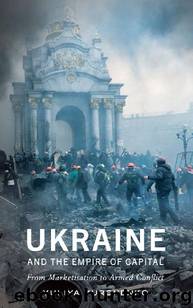
Ukraine and the Empire of Capital: From Marketisation to Armed Conflict by Yuliya Yurchenko
Author:Yuliya Yurchenko [Yurchenko, Yuliya]
Language: eng
Format: epub
ISBN: 9781786801838
Publisher: Pluto Press
Published: 2017-12-20T00:00:00+00:00
DCFTA: TIME TO GATHER STONES
The DCFTA entailed a series of reforms that went beyond deepening of trade relations. Ukraine already has a series of Free Trade Agreements with the EU, yet those were relatively limited in scope and were based on quota import–export model with selective tariff reductions. The new agreement was planned to take the relationship between the parties to a new, deeper level. It also included visa-free non-work travel for Ukrainian citizens – something Brussels felt was important to give to Kyiv since Ukraine’s full EU membership aspirations were met with little enthusiasm by some of the Union’s member states. DCFTA was aimed at ‘facilitating convergence to the EU standards in various business-related regulations in the areas of food safety, technical standards, public procurement, competition policy, intellectual and property rights, etc. (‘deep’ and ‘comprehensive’ aspects).’4
DCFTA is the most far-reaching treaty that the EU has signed to date (except for membership treaties). In a recent analysis of its effects on the signatory countries, Amat Adarov and Peter Havlik conclude that in the long term, the economic effects are ‘likely to be positive due to the ultimate convergence of the beneficiary economies to a more competitive state underpinned by better institutions, a more predictable and transparent legal setting, improved investment climate, as well as improvements along other dimensions,’5 if implementation is successful. At the same time, they warn that ‘the net benefits are highly asymmetric along the time dimension (high costs in the short and medium run – benefits accruing mostly in the longer run)’6 and divergence ‘across regions and economic sectors’ is high (less competitive sectors and regions will face particularly onerous adjustment costs). There are sizeable associated ‘costs, challenges and risks’ that:
include, among others, fiscal costs of the legal approximation to the EU acquis, losses of traditional export markets, challenges of finding a market niche in the already highly competitive European markets, adjustment costs related to industrial restructuring leading to contraction of less efficient industries with potentially painful concurrent labour market repercussions, investment needs by the public and the private sector to finance the implementation of reforms and bridging the ‘gaps’ in infrastructure and productivity.7
Download
This site does not store any files on its server. We only index and link to content provided by other sites. Please contact the content providers to delete copyright contents if any and email us, we'll remove relevant links or contents immediately.
| Arms Control | Diplomacy |
| Security | Trades & Tariffs |
| Treaties | African |
| Asian | Australian & Oceanian |
| Canadian | Caribbean & Latin American |
| European | Middle Eastern |
| Russian & Former Soviet Union |
The Secret History by Donna Tartt(19311)
The Social Justice Warrior Handbook by Lisa De Pasquale(12225)
Thirteen Reasons Why by Jay Asher(8999)
This Is How You Lose Her by Junot Diaz(6960)
Weapons of Math Destruction by Cathy O'Neil(6371)
Zero to One by Peter Thiel(5873)
Beartown by Fredrik Backman(5845)
The Myth of the Strong Leader by Archie Brown(5552)
The Fire Next Time by James Baldwin(5506)
How Democracies Die by Steven Levitsky & Daniel Ziblatt(5275)
Promise Me, Dad by Joe Biden(5192)
Stone's Rules by Roger Stone(5132)
A Higher Loyalty: Truth, Lies, and Leadership by James Comey(5019)
100 Deadly Skills by Clint Emerson(4974)
Rise and Kill First by Ronen Bergman(4840)
Secrecy World by Jake Bernstein(4804)
The David Icke Guide to the Global Conspiracy (and how to end it) by David Icke(4773)
The Doomsday Machine by Daniel Ellsberg(4556)
The Farm by Tom Rob Smith(4551)
